
Successful Brand (Re)positioning
Let’s imagine for a moment that a dental clinic decides to add medical-aesthetic treatments to its range of services.
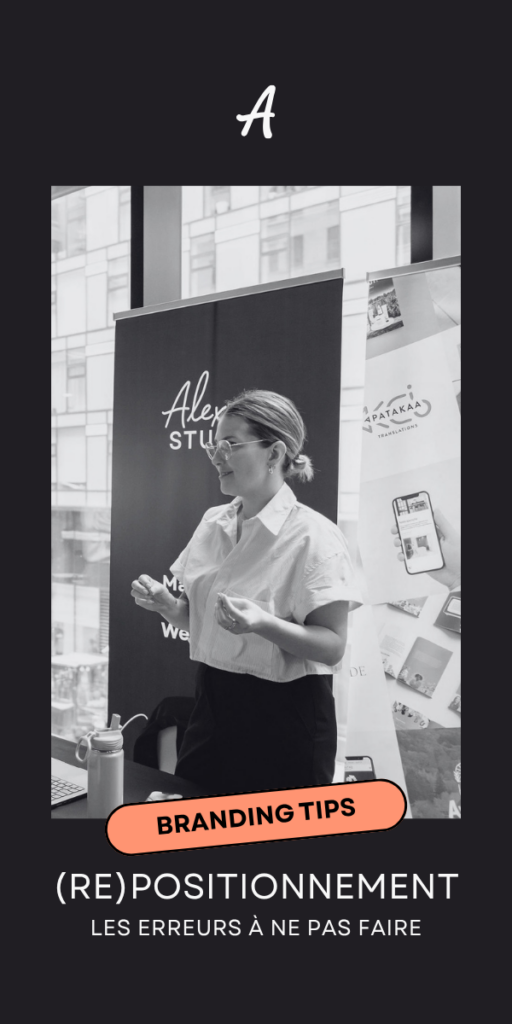
This is a real-life scenario: several dentists are currently adding this skill to their repertoire following a change in the licensing requirements of their professional association. This was, in fact, the topic of the presentation that Alexe, founder of Alexem Studio, gave at the RDV DPQ event in September 2025.
On paper, it all makes sense: orofacial expertise, mastery of injections, precision down to the millimeter. However, one obstacle remains, and it is neither technical nor regulatory. It’s in people’s minds. When we think of a “dentist,” we think of cavities, fillings, and teeth whitening. We don’t think of the face, skin, or aesthetics.
This is a problem faced by any company whose offerings evolve faster than its brand image. Brand positioning is the place your company occupies in your customers’ minds. It’s what sets you apart from the competition, what makes you memorable, and what allows your audience to quickly understand who you are, what you do, and why you do it.
It all starts with brand perception
Even before reading a single word or interacting with you, people have already formed an impression of who you are. A pastel logo, handwritten typography, a cheerful tone: instinctively, people think of a gentle, human-centered company, perhaps associated with childhood or well-being. Conversely, a black-and-white design, clean lines, and a confident tone will evoke a high-end or tech-oriented world.
This is what’s known as brand perception. It’s built on visual and cultural codes rooted in our collective imagination. We associate certain colors, words, and graphic elements with specific industries: baby stores, real estate agencies, design studios, law firms. Each has its own codes.
These codes are useful when they work in your favor. They become a hindrance when your offerings change but your image remains the same. Our dental clinic is a perfect example of this: its capabilities have evolved, but the image it projects remains that of a traditional dental practice. It is precisely this disconnect that brand repositioning is designed to correct.
If you don’t actively establish your brand’s position in your customers’ minds, these stereotypes will do it for you. Positioning your business effectively means regaining control over that perception.
Step 1: The Brand Audit
Before doing anything, there’s one essential step: a brand audit. You don’t change a company’s image on a whim. You have to understand what works, what needs to be adjusted, and what needs to be added. You don’t just throw everything away—you analyze, rethink, and improve.
Three honest questions to start with:
- What does someone who sees your logo for the first time actually perceive?
- What does your website say about your company, and what kind of atmosphere does it convey?
- Are your social media, your storefront, your printed materials, and your customer service consistent with your current or desired positioning?
For our dental clinic, the question would be this: What does someone looking for cosmetic dental care understand when they visit your current website? Most likely, they’re in the wrong place.
Points to Consider
We focus on every point of contact between your brand and your audience.
Visual identity
- Does your logo reflect your brand’s personality?
- Do your colors and fonts evoke the right emotions?
- Are these elements used consistently across your media?
Website and Digital Tools
- Is the online experience seamless, engaging, and accessible?
- Are good messages clear right from the start?
- Do the images, navigation, and text tell the same story across all your platforms?
Speech
- Do the words you use reflect who you are?
- Are your texts aligned with your mission, values, and ambitions?
- Are you clear about what you offer and who it’s for?
A Real-Life Experience
- Do your customers have a consistent experience, from the first impression through to the delivery of the service or product?
- Do your partners and employees know how to present your company?
How to Conduct This Audit
Internally. Gather your team and review all your current communication materials. Be critical, open-minded, and constructive. Having to make adjustments doesn’t mean your previous branding was a mistake—the goal is to evolve the whole thing to align with your most up-to-date objectives.
With your customers. Just ask them what they think of you. The words they use are very revealing. You can also ask the people around you—even those who aren’t familiar with your field.
From an outside perspective. Entrust this analysis to a branding agency or specialist (hey, that’s us!), who can provide an unbiased and informed perspective.
Why don’t we skip this step?
A brand may have great products, impeccable service, and a solid vision, but if its image is confusing or contradictory, trust won’t follow. A customer visits your website after hearing positive word-of-mouth and is met with an outdated interface, a blurry logo, and unclear messaging. They’ll immediately think, “This might not be for me.” You’ve evolved, but your image hasn’t kept up—and you’re missing out on opportunities.
It may be tempting to dive headfirst into a visual redesign, but without a preliminary audit, you run the risk of simply giving it a new look without addressing the real issues.
Step 2: Choose your positioning
An audit tells you where you are. Positioning, on the other hand, tells you where you’re going. Let’s go back to the example of the dental clinic. Two paths lie ahead, and they lead to very different brands.
Capitalizing on Your Specialization
Stay within your area of expertise and excel at it better than anyone else.
The benefits: a simple, clear, and easy-to-understand message; expertise that is well-defined rather than diluted; and the opportunity to become the undisputed leader in a specific niche.
The risks: missing out on an opportunity for growth, failing to meet actual demand, and falling behind in your field while others take the lead.
Expand its product line
Add a new territory and reposition the brand to accommodate it.
The benefits: a broader customer base, the opportunity to take the lead in a growing market, and the chance to showcase the expertise you already possess.
The risks: a poorly managed transition, a muddled message, and current clients who no longer identify with your business. In the case of the clinic, long-time patients might wonder whether the practice remains committed to providing quality care.
Maintain or Evolve Your Identity
If you choose to expand your product or service offering, you’ll face a second decision. It’s more nuanced, but often more critical than the first.
Keeping your current brand identity reassures your existing customers, allows you to test the waters, and enables you to move forward gradually. On the other hand, the new service will continue to be perceived as secondary for longer, and this identity will limit your future opportunities.
Evolving your brand identity highlights the uniqueness of your offering, attracts new customers, and positions you as an industry leader. On the other hand, there is a real risk of confusion if the transition is poorly managed, and the workload is greater.
One criterion: consistency
There’s no right or wrong answer. A specialized brand that stands by its identity works. A broad-based brand that stands by its identity works, too. What doesn’t work is a brand that tries to do both half-heartedly—one that talks about high-end products on its website and discounts on social media, or that announces a new service without ever incorporating it visually. The key is to be clear, consistent, and confident.
Step 3: Translate the positioning into a brand identity
A position that remains merely on paper doesn’t make a difference. It must translate into concrete actions that your audience can see and feel.
Visual Identity
Every industry has its own norms, and you need to know where you stand in relation to them.
Let’s go back to our dental clinic. The conventions of dentistry: blue or green, tooth-shaped logos, clean, angular typefaces, and rather cool-toned photos of the office. The message is one of cleanliness and clinical competence.
The hallmarks of medical aesthetics? A high-end world, photos focused on the face and skin, elegant and minimalist typography, and an overall sense of gentleness and confidence.
Moving from one brand identity to another isn’t as simple as adding a “Services” page. It requires revising the color palette, typography, photography, and layout of all your materials. It’s this work that makes the new positioning credible even before a single word is read.
The Brand’s History
Your motivations, mission, and values give change its purpose. In the case of our clinic, the story isn’t “we’re adding a service” but rather “our expertise in facial treatments naturally leads us here.” The first phrasing sounds like a business decision; the second, like a logical extension of our services, which immediately puts the audience at ease.
The Brand Voice
Your voice is defined by the words you choose to use and those you choose not to use. In a field where trust is essential—as in our example—four key elements of tone are essential: precision, restraint, clarity, and humanity.
Words to emphasize: natural, precise, appropriate, controlled.
Words to avoid: miracle, guaranteed, fast, sale.
The difference is immediately apparent in how the same service is described. “Anti-wrinkle injections, guaranteed results, special offer this month!” raises suspicion. “Precise treatments, tailored to your face, performed by a team that already knows it well” inspires confidence. The service is identical, but the perception is not.
Step 4: Deploy across the entire ecosystem
Brand positioning is experienced across all touchpoints. A single inconsistent element is enough to undo the work of the others.
The Digital Ecosystem
The website remains the centerpiece: an up-to-date brand identity, high-quality photographs, a clear presentation of services, non-pushy calls to action, and truly useful content.
Social media channels convey the brand’s personality, social proof, and day-to-day communication.
Advertisements and online profiles (Google listings, directories, booking platforms) are often the very first point of contact, yet they are the most overlooked aspects.
The Physical Ecosystem
The exterior, the interior design, stationery, posters, hand-delivered documents, and promotional items. A clinic positioned as high-end whose waiting room hasn’t changed in fifteen years sends two conflicting messages, and it’s the one experienced on-site that prevails.
The Complete Customer Journey
Advertising, landing page, website, email, online discovery, social media, consultation, service provided, post-service evaluation. The customer doesn’t see nine separate elements—they take away a single impression, and it’s the weakest link that shapes that impression.
Step 5: The Game Plan
A comprehensive repositioning typically takes place over several months, in three overlapping phases.
Phase 1: Brand audit, defining your positioning, drafting the brief, and selecting the individuals or studio that will work with you.
Phase 2: Redesign or update the brand identity, followed by the website, social media, and newsletter. First campaigns.
Phase 3: signage, printed materials, search engine optimization, and then tracking the results: Has perception changed, and are the new inquiries coming from the right people?
Order is more important than the timeline. Many companies start with Phase 2—sometimes even Phase 3—and later realize that they have created great tools to support a positioning strategy that was never actually defined.
Key Takeaways
Brand positioning isn’t just about aesthetics. It’s a strategic decision that then shapes every color choice, every word on a services page, and every detail of the customer experience.
Our dental clinic didn’t have a problem with competence. It had a problem with perception, and perception isn’t corrected by adding an item to the list of services. It’s corrected by clearly defining where we stand, and then reflecting that stance in everything we do, without exception.
Does this sound familiar? Or are you simply wondering if your brand image still reflects what you do today? Drop us a line—we always start with a conversation!